
If you’ve lived in the Treasure Valley for a smoke season, you know the drill: hazy skies, that campfire smell indoors, days (sometimes weeks) of “check the AQI before you head out.” For families with babies, young kids, or teens, that check matters more than you might think.

Why kids are more vulnerable than adults
It’s not just that children are smaller — their bodies handle air differently. Infants and children are particularly vulnerable to air pollution because their bodies are still developing rapidly, and they take in more air relative to their body weight than adults do. Kids also breathe nearly twice as fast as adults, drawing in more of whatever is in the air relative to their size.
What’s actually in wildfire smoke?
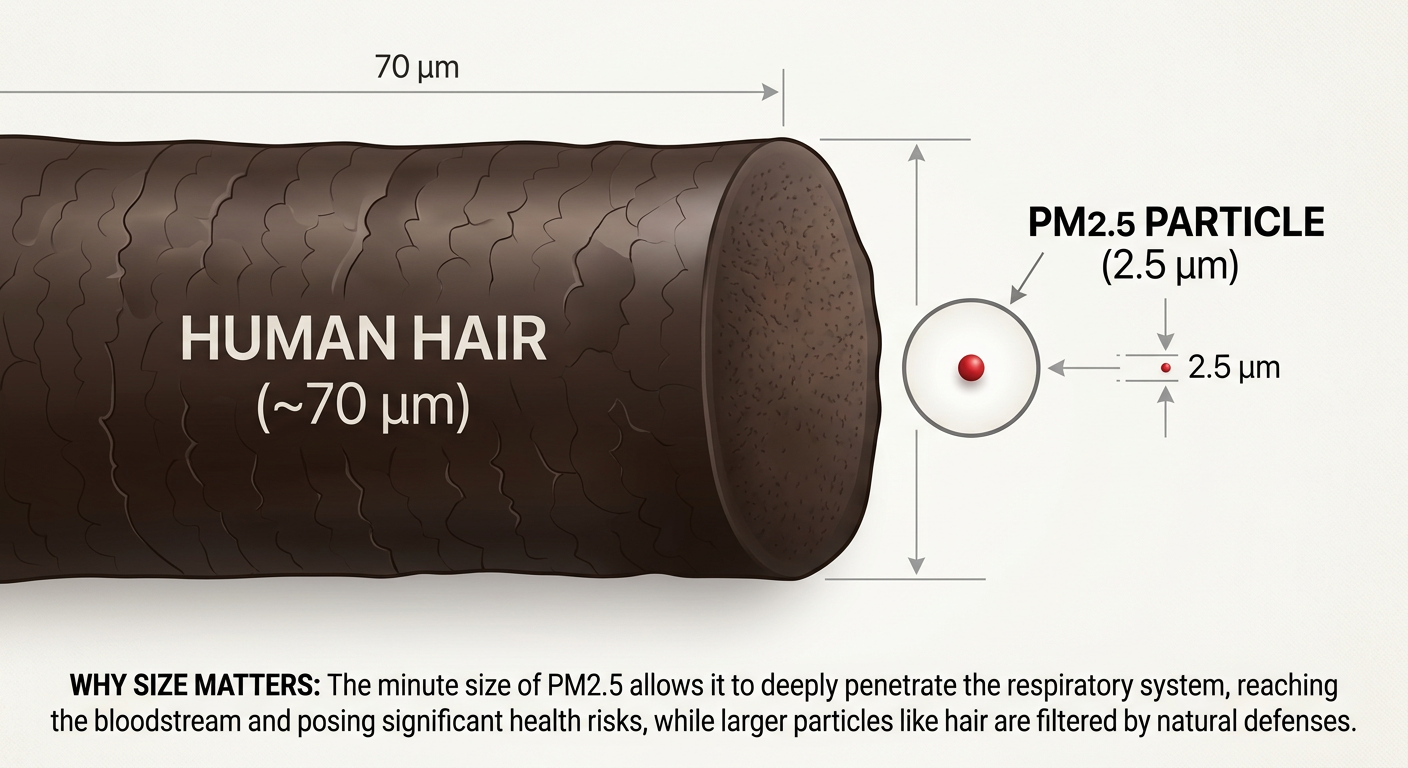
The main pollutant of concern in wildfire smoke is something called PM2.5 — fine particulate matter 2.5 micrometers or smaller. To picture that: a human hair is 30 times wider than PM2.5 particles. They’re too small to see individually, and small enough to slip past the body’s usual filters — traveling deep into the lungs and even into the bloodstream. PM2.5 makes up around 90% of the total particle mass that wildfires release- tar, soot, minerals and ash – which is why it’s the number driving most of those hazy, red-and-purple AQI days in the Boise area during late summer and fall.
How bad is “bad”? A helpful comparison
Because PM2.5 is invisible and the AQI is just a number, it can be hard to grasp what a given day’s exposure actually means. One way researchers have made this more tangible: comparing long-term PM2.5 exposure to cigarette smoking. Using this method, an average daily PM2.5 level of about 22 micrograms per cubic meter over 24 hours is roughly equivalent, in long-term health impact, to smoking one cigarette that day. One recent analysis using this method estimated that Boise’s average annual PM2.5 was equivalent to smoking around 171 cigarettes a year — largely driven by wildfire smoke season — putting it among the higher-exposure cities in the country that year.
A couple of important caveats: this is a population-level analogy about long-term health risk, not a literal statement that a smoky afternoon equals a cigarette in your child’s lungs. And children weren’t part of the original calculation, which was based on adult mortality data — but it’s a useful way to understand why pediatricians take multi-day smoke events seriously, especially for kids, whose developing lungs are more sensitive to fine particles than adult lungs.
What poor air quality can do to kids
Beyond the “smoky day” feeling, the effects can be more significant over time. According to the American Academy of Pediatrics, air pollution has been shown to worsen chronic conditions like asthma, and has also been associated with preterm birth, abnormal lung and neurological development, pediatric cancer, obesity, and cardiovascular disease risk. Research also points to a role for air pollution in infant respiratory mortality, the development of childhood asthma, and reduced lung function growth.
On the more immediate side, ground-level ozone and fine particles can irritate the respiratory system — causing coughing, throat irritation, chest tightness, wheezing, or shortness of breath — and can trigger asthma attacks.
Indoors matters too. Kids spend up to 90% of their time indoors, and during smoke events indoor pollutant levels can climb close to outdoor levels without any intervention. Poor indoor air quality makes children more vulnerable to colds, coughs, ear infections, bronchitis, and pneumonia, and can trigger flare-ups in kids with allergies or asthma.
Know the AQI (Air Quality Index)
The AQI is a free daily tool (available at airnow.gov or the AirNow app) that tells you how clean or polluted the air is and what precautions to take. General guidance for children and child care settings:
AQI Level |
What it means for kids |
|---|---|
| 0–50 (Good) | A great day to be active outside. |
| 51–100 (Moderate) | A good day to be active outside, though some sensitive children may notice increased symptoms — follow any asthma action plan. |
| 101–150 (Unhealthy for Sensitive Groups) | Short, low-impact outdoor activities like recess are fine; sensitive children should avoid strenuous or prolonged (over an hour) outdoor activity, with more breaks and monitoring for symptoms. |
| 151+ (Unhealthy and above) | Public health guidance recommends limiting young children’s outdoor time to 15-minute intervals, and checking a local air quality monitor before going out. During a multi-day smoke event, plan for several consecutive indoor days. |
What to do
- Check the AQI daily during smoke season — Boise’s late summer/fall stretches can shift from moderate to unhealthy over a single afternoon.
- Keep quick, low-impact outdoor activity in mind on moderate days — a walk is different from an hour of soccer practice.
- Improve your indoor air on bad-air days. Run your HVAC system, use high-efficiency filters rated MERV-13 or higher, and set the system to recirculate rather than pull in outside air.
- Have an asthma action plan on hand if your child has asthma or another respiratory condition, and follow it during poor air quality stretches.
- Plan ahead for multi-day smoke events — line up indoor activities in advance so a string of red/purple AQI days doesn’t mean a string of bored, cooped-up kids.
- Talk to your pediatrician about your child’s individual risk, especially for infants, kids with asthma or heart conditions, or during pregnancy.
What not to do
- Don’t rely on masks to protect young children from smoke. Paint, dust, cloth, and surgical masks — even N95 masks — are generally not made to properly fit young children and won’t reliably protect them from wildfire smoke. Guidance varies by age and mask type for older kids, so check with your pediatrician.
- Don’t assume indoor air is automatically safe during a smoke event without taking steps to filter it.
- Don’t push through strenuous outdoor activity on orange/red AQI days, even if your child feels fine at first — symptoms can show up after exposure builds.
- Don’t ignore mild symptoms like a new cough, unusual tiredness, or throat irritation on smoky days — these are worth mentioning to your pediatrician.
The bottom line
Boise’s smoke season isn’t going away, but a quick AQI check can help you make simple, protective calls: shorter outdoor time, an indoor filter running, or just keeping the inhaler within reach during those multi-day stretches.
Have questions about your child’s specific risk factors? That’s exactly what we’re here for — reach out anytime.
Sources: CDC, EPA AirNow.gov and EPA Particulate Matter Basics, American Academy of Pediatrics / HealthyChildren.org, NYC Department of Health, Berkeley Earth (PM2.5–cigarette equivalence methodology)
